
Physical Platform
The hull, propulsion system, machinery and structural components remain the vessel's physical foundation.
Foundation:
Software intelligence still depends on a reliable physical vessel.
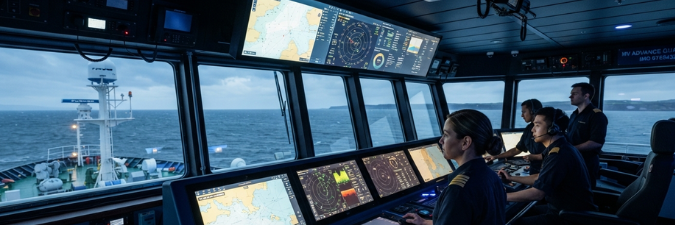
For the next century, they will increasingly be defined by software.
For most of maritime history, competitive advantage was measured in physical terms. Shipowners invested in stronger hulls, larger cargo capacities, more efficient engines, and faster vessels. Innovation was visible—you could stand on a quay and see it.
Today, the next wave of innovation is largely invisible.
It exists in algorithms, cloud platforms, sensor networks, artificial intelligence, digital twins, and predictive analytics. The vessels of the future will not simply move cargo more efficiently because they have better engines. They will move cargo more intelligently because they make better decisions.
The maritime industry is entering a new era.
At AD Marina, we describe this transformation as the Software-Defined Ship (SDS).
It is a framework that explains how software is becoming just as strategically important as steel in determining the performance, safety, efficiency, and commercial value of modern vessels.
This is not simply another digital transformation initiative.
It is a fundamental shift in how ships are designed, operated, maintained, and continuously improved throughout their operational lives.
A century ago, improvements in shipping came from engineering breakthroughs.
Steam replaced sail.
Diesel replaced steam.
Radar improved navigation.
Satellite positioning transformed route planning.
Electronic chart systems replaced paper charts.
Each innovation added another piece of equipment to the bridge.
Artificial intelligence changes something much bigger.
Instead of adding another system, AI connects existing systems into a single intelligent ecosystem.
Navigation data informs maintenance.
Engine performance influences voyage planning.
Weather forecasts adjust fuel consumption.
Cargo information affects arrival times.
Port congestion reshapes routing decisions.
The vessel no longer operates as a collection of independent technologies.
It becomes an integrated digital platform.
That is the defining characteristic of the Software-Defined Ship.
A Software-Defined Ship (SDS) is a vessel whose operational capability, efficiency, safety, and commercial performance are increasingly determined by software, data, connectivity, and intelligent decision-support systems rather than hardware alone.
Traditional vessels improve when hardware is replaced.
Software-defined ships improve through:
The hull may remain unchanged for twenty-five years.
Its intelligence can improve every month.
That changes the economics of shipping.
The maritime industry has experienced technological revolutions before, but today’s transformation is different.
Consider the evolution of the mobile phone.
Early phones competed on battery life, antenna strength, and physical design.
Then smartphones arrived.
Suddenly, the device became a platform rather than a product. New capabilities could be added years after purchase through software updates and applications.
Ships are beginning to follow the same path.
The vessel becomes the hardware.
Software becomes the product that continuously evolves.
A ship delivered in 2035 may operate far more intelligently in 2040—not because its engines have changed, but because its software has.
Every Software-Defined Ship can be understood through seven connected layers.
Explore the connected layers that transform a conventional vessel into an intelligent maritime platform.
The hull, propulsion system, machinery and structural components remain the vessel's physical foundation.
Thousands of sensors continuously monitor engines, fuel systems, cargo conditions, structural stress, weather and onboard operations.
Satellite communications, onboard networks and cloud infrastructure enable continuous data exchange between ship and shore.
Artificial intelligence transforms raw operational data into predictions, recommendations and optimised decisions.
A live virtual replica enables engineers to simulate maintenance, voyage scenarios, emissions performance and operational risks before implementing changes.
Navigation, compliance, maintenance, fleet management, emissions reporting, cargo optimisation and cybersecurity operate as interconnected software services.
Captains, officers, engineers, fleet managers and shore teams remain central to decision-making. Software enhances judgement—it does not eliminate it.
The impact extends far beyond navigation.
Engineering departments use predictive maintenance to detect machinery failures before they occur.
Fleet managers optimize fuel consumption across entire fleets using AI-driven analytics.
Cargo planners forecast loading efficiencies based on historical operational patterns.
Compliance teams automate emissions reporting and regulatory documentation.
Ports use intelligent berth allocation and predictive congestion analysis.
Insurers increasingly assess operational risk using real-time vessel performance data.
Shipping companies are no longer purchasing isolated technologies.
They are building connected digital ecosystems.
Software changes more than operations.
It changes revenue.
Shipowners may increasingly purchase ongoing digital services rather than relying solely on hardware upgrades.
Future vessels could include:
The commercial value of a vessel may become increasingly linked to the intelligence of its software ecosystem.
Every transformation introduces new challenges.
Cybersecurity becomes operational safety.
Data ownership becomes a commercial asset.
Software failures become operational risks.
Artificial intelligence requires governance, transparency, and human oversight.
Interoperability between vendors will become increasingly important.
Regulators must adapt alongside technology.
Software-defined shipping is not risk-free.
It is risk-transformed.
The ships of tomorrow will still require exceptional naval architecture.
They will still depend on skilled crews.
They will still navigate challenging oceans.
But increasingly, their competitive advantage will come from something that cannot be seen from the dock.
Software.
Algorithms.
Artificial intelligence.
Data.
The future of shipping will not simply be built in shipyards.
It will also be written in code.
The organizations that recognize this shift early will not simply adopt the future.
They will help define it.
The ships of tomorrow will still require exceptional naval architecture.
They will still depend on skilled crews.
They will still navigate challenging oceans.
But increasingly, their competitive advantage will come from something that cannot be seen from the dock.
Software.
Algorithms.
Artificial intelligence.
Data.
The future of shipping will not simply be built in shipyards.
It will also be written in code.
The organizations that recognize this shift early will not simply adopt the future.
They will help define it.
Steel will continue to carry the cargo.
Software will increasingly determine how efficiently, safely, and profitably that cargo reaches its destination.
The age of the Software-Defined Ship has begun.
AD Marina is a maritime technology company focused on digital transformation, artificial intelligence, maritime innovation and operational intelligence for the global shipping industry. Through research, technology and data-driven insights, we help shape conversations about the future of maritime operations.