
The Dawn of Autonomous Passenger Shipping: How the Olympia Dream Seto Is Rewriting Maritime Tech in 2026
Introduction — The Future of Passenger Shipping Is Here
For over a century, human captains and crews were indispensable to maritime travel. That changed in 2026 with the Olympia Dream Seto — the world’s first passenger ship that can navigate without a captain or crew using sophisticated autonomous systems.
This isn’t a small water taxi in a sheltered harbour — it’s a full-sized commercial ferry operating in one of the busiest, most congested sea lanes on the planet, and it’s proving that AI-powered autonomy is not a distant dream, but a present-day reality.
In this post, we unpack the technology behind this milestone, why it matters for global shipping, and how it accelerates the transformation toward Maritime Autonomous Surface Ships (MASS) — a core next frontier for maritime innovation.
Olympia Dream Seto: A Floating Supercomputer
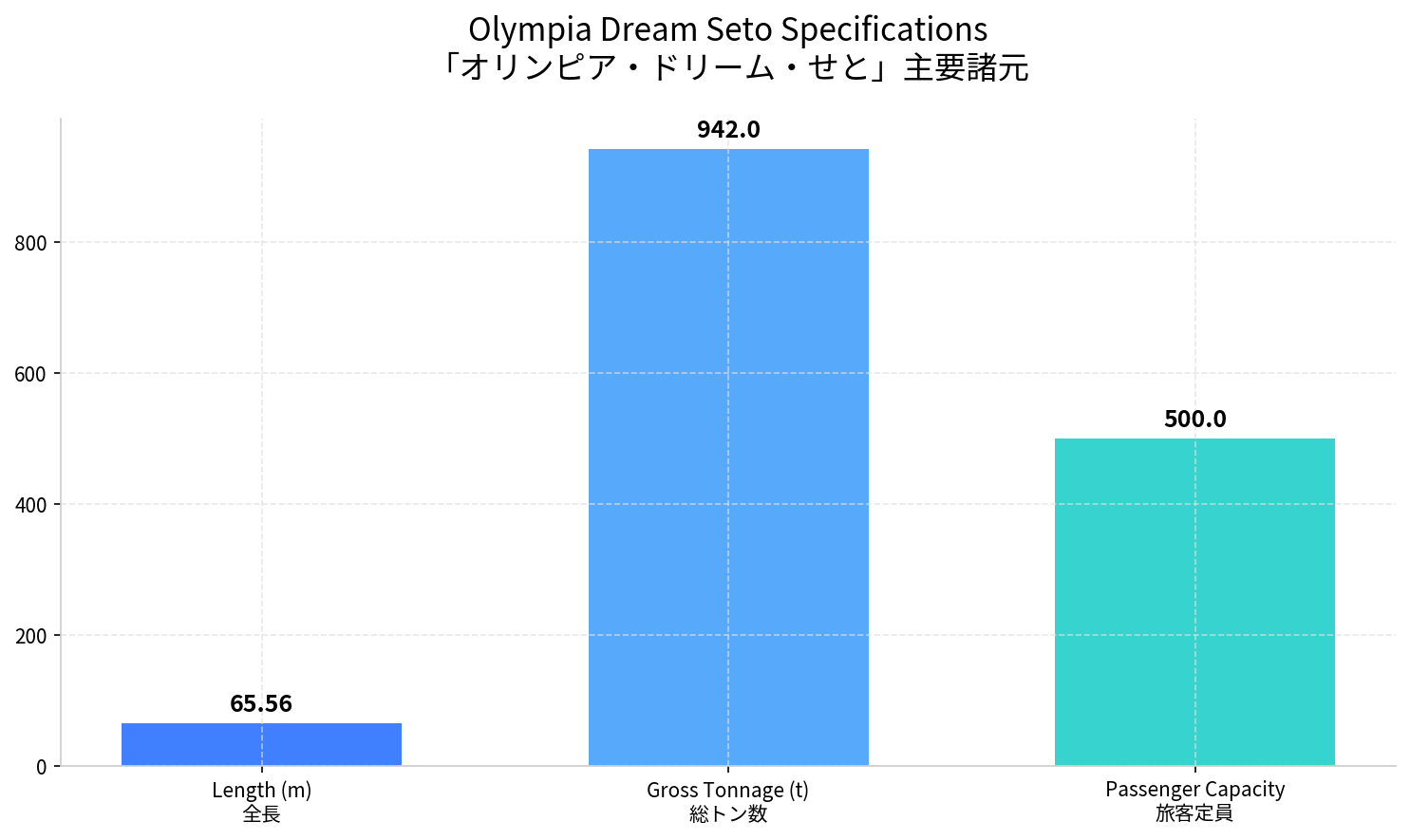
The Olympia Dream Seto measures 65.56 m in length with a gross tonnage of 942 t and carries up to 500 passengers, operating between Shin-Okayama and Tonosho Port in Japan’s Seto Inland Sea.
This waterway is notoriously busy, crowded with fishing boats, cargo ships, floating debris, and complex navigation challenges — making its successful autonomous operation a real test of maritime AI capability.
Sensor Fusion & AI Navigation
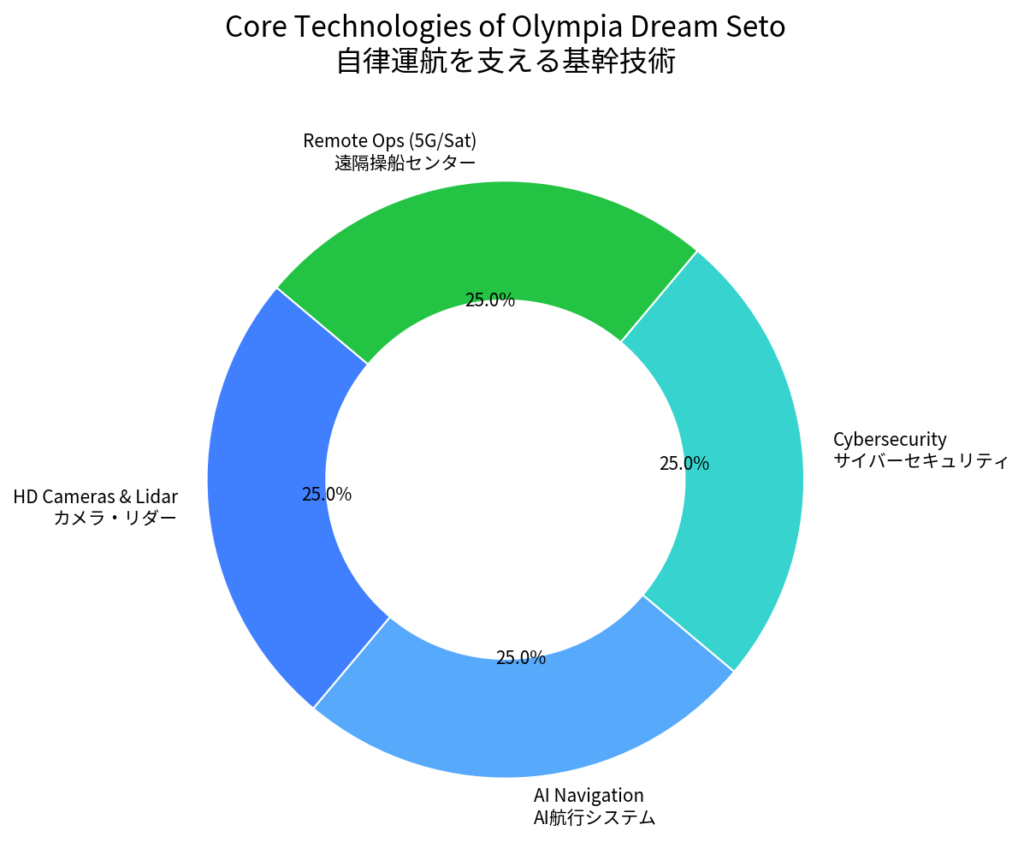
At the heart of the vessel is a sophisticated sensor fusion system — essentially a floating supercomputer that processes massive amounts of data in real time.
Key technologies onboard include:
LiDAR & HD cameras: Creating a detailed 3D map of surrounding obstacles.
Predictive modeling: Predicts nearby vessel movements and adjusts course proactively.
AI navigation algorithms: Navigate safely through mixed traffic environments, something traditionally managed by human captains.
These systems aren’t just reactive; they anticipate changes in traffic patterns and environmental conditions seconds before they occur — an advantage even experienced human captains may lack.
Cybersecurity & Remote Operations
Safety is built into the architecture:
Military-grade encryption protects ship-to-shore communications.
A Remote Operations Centre (ROC) monitors the vessel and can intervene if necessary.
This hybrid setup — AI automation with shore-based oversight — is crucial for real-world adoption while regulatory frameworks catch up.
Why Japan Pioneered Autonomous Passenger Shipping
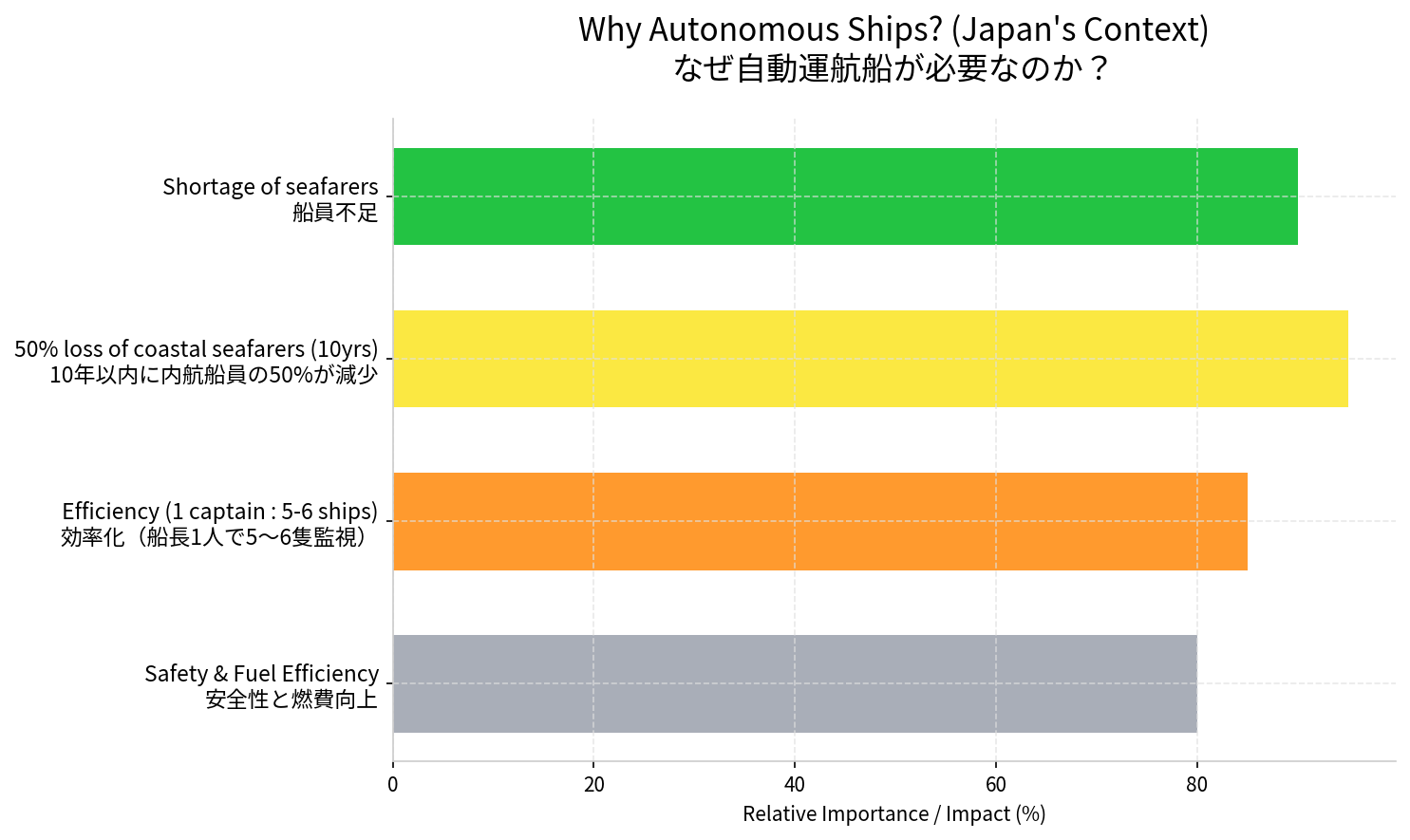
Japan’s maritime sector faces a demographic challenge known as the “Silver Tsunami” — an aging workforce with fewer young seafarers entering the profession.
Autonomous vessels like the Olympia Dream Seto help address:
Crew shortages
Operational reliability
Cost efficiency
Consistency of service
Importantly, one human operator on shore can oversee multiple autonomous vessels simultaneously, a paradigm shift from traditional seafaring.
Autonomous Ships on the Horizon — Not Just a Prototype
The Olympia Dream Seto isn’t the only autonomous vessel in development — it’s the most significant milestone yet. Autonomous technology is advancing on multiple fronts:
MASS definitions and regulations are being developed by the International Maritime Organization (IMO) to standardise autonomous operations.
Other autonomous ship concepts (e.g., autonomous cargo vessels and research drones) are testing similar technologies.
Autonomy is emerging not just through sensors and AI, but through the entire ecosystem of navigation, regulation, simulation, and testing frameworks.
The Technology Stack That Makes Autonomy Possible
Here’s a high-level look at the technological backbone enabling vessels like Olympia Dream Seto:
| Layer | Technology | Function |
|---|---|---|
| Perception | LiDAR HD cameras | 3D environment mapping |
| Navigation | AI predictive algorithms | Dynamic route planning |
| Connectivity | 5G Satellite comms | Remote monitoring & control |
| Cybersecurity | Encryption Segmentation | Protects operational integrity |
| AI Decision-Making | Sensor fusion Predictive data | Collision avoidance & optimisation |
This stack mirrors what future Maritime Autonomous Surface Ships (MASS) are expected to adopt industry-wide.
Regulatory Roadblocks & the IMO’s MASS Code
A major challenge has been international maritime law. Traditional rules (like the COLREGs requirement for human lookout) assume the presence of humans onboard — a direct conflict with autonomy.
To resolve this, the IMO is developing a MASS Code that shifts from prescriptive rules (you must have humans onboard) to performance-based standards (the vessel must detect and avoid obstacles as well as a human).
Data collected by the Olympia Dream Seto is feeding directly into this process, accelerating regulatory acceptance and helping define how autonomous vessels can safely integrate into global routes.
What This Means for Maritime Technology & Shipping Organisations
The successful operation of a fully autonomous passenger ferry in real commercial conditions is a watershed moment. Here’s why it matters:
Operational Resilience
Autonomous navigation systems reduce reliance on scarce human crew, improving reliability and schedule adherence.
Data-Driven Decision Making
AI systems gather far more environmental data than a human could — offering insights into traffic patterns, weather, and optimal navigation strategies.
Cost Structure Redefined
Crew costs, rest requirements, and human error factors — major cost drivers in shipping — are significantly reduced.
Regulatory Evolution
Crew costs, rest requirements, aReal-world data accelerates safe integration of autonomous vessels into the regulatory framework of the IMO.d human error factors — major cost drivers in shipping — are significantly reduced.
Conclusion — The Autonomous Voyage Has Begun
The Olympia Dream Seto is more than an innovation — it’s a proof of concept that autonomous technology can safely navigate dense, real-world sea routes with passengers.
As maritime AI, sensor fusion, and regulatory advancements converge, we are witnessing a transformation that will redefine how vessels operate — from cargo ships to passenger ferries and beyond.
This is not tomorrow’s ship — it’s already sailing today.
AD Marina — Navigating Maritime Technology.